Blogs
Trust and Safety in Gaming (Part 2): How Much Can Disruptive Behavior Cost Your Bottom Line?

5 March 2025
By Ling Quek
VP of Trust & Safety (Global Client Solutions)
US$321 billion. That’s how much the gaming industry is expected to be worth next year. With more players, bigger budgets, live-service ecosystems, in-game economies, and high-profile esports leagues, gaming is a cultural and economic force that can drive your growth margins forward.
But if trust and safety aren’t your priority today, what does that mean for your bottom line tomorrow?
A thriving community is just as critical as the gameplay itself. When negative player interactions go unchecked, engagement drops. Some players leave quietly. Others make it known. Either way, they’re taking their time, attention, and spending power with them. A gaming analytics firm estimated that first-person shooters (FPS) alone could lose US$1.6 billion. That’s based on 2023 data on player retention against a US$10-billion annual recurring revenue (ARR) market for FPS titles. In esports, where at least 58% of revenue comes from sponsorships, brands won’t hesitate to pull their support if a game and its community become infamous for hostility.
Our own survey puts the risks into focus. In the first part of our series, we highlighted that 65% of players across seven countries said they’ve quit or are likely to quit a game due to toxicity — player behaviors that disrupt, harm, or degrade the gaming experience for others. That’s already a staggering loss, but when we look at who is leaving, the stakes get higher.
Beyond the game, what happens to the bottom line when players walk away?
Ensuring trust and safety in gaming is a business decision, too. Let’s extrapolate numbers from our survey and connect the dots.
Based on industry benchmarks, the forecasted market value of the gaming industry in 2024 was US$447.31 billion. The estimated number of players worldwide sits at 1.3 billion, while the average annual spending per gamer is US$341.46. Adapting a 65% churn translates to 852 million gamers who would quit a game due to disruptive player behavior. The estimated loss? US$290.92 billion. That doesn’t account for the long-term impact on brand reputation, engagement, and player lifetime value.
Those who stay? Many spend less. In fact, 61% of players who experience negative behavior reduce their in-game spending, while 24% avoid spending entirely because of how other players behave. In a study by the developers of a multiplayer online battle arena (MOBA), first-time players encountering disruptive behaviors are 320% more likely to churn.
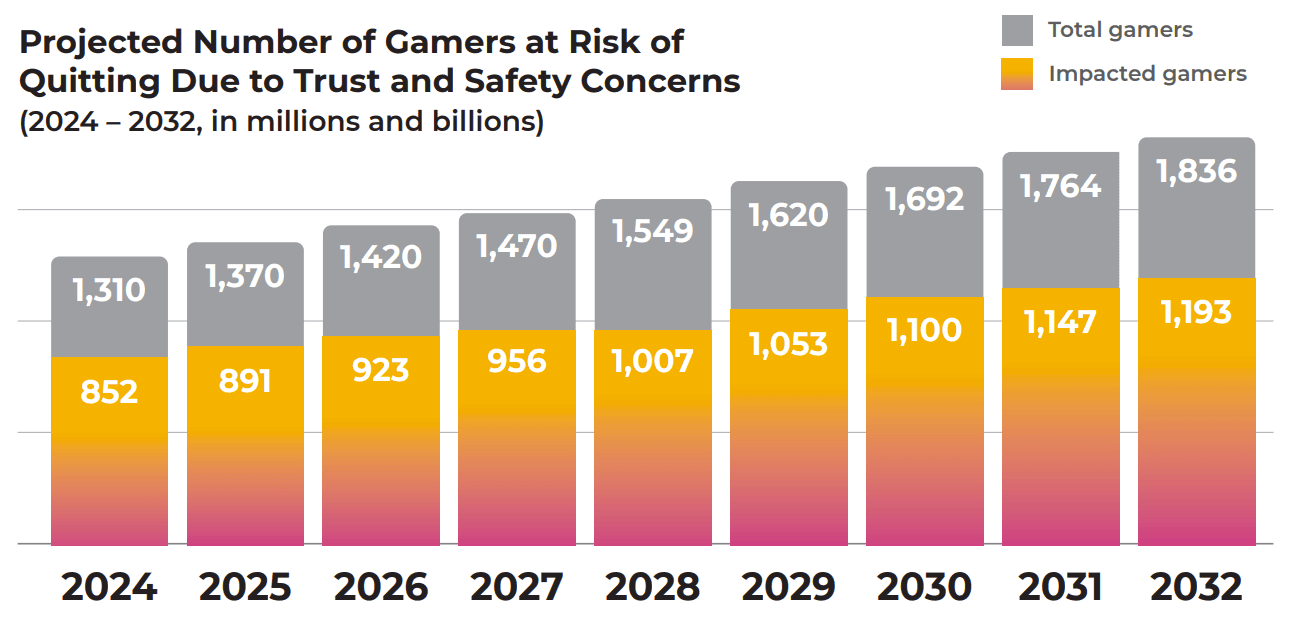
Adapting a 65% player churn risk to the global gaming population highlights the scale of potential losses.
The financial impact doesn’t stop at player churn. There’s regulatory oversight, too. In the EU, the Digital Services Act (DSA) requires gaming companies to moderate harmful content and report their enforcement measures. Noncompliance carries fines of up to 6% of a company’s annual global turnover. In the UK, the Online Safety Act enforces penalties of £18 million or up to 10% of a company’s annual global revenue for failing to prevent harmful interactions on digital platforms.
Others are following suit. New and pending regulations in Australia, Ireland, and Singapore point to a global shift toward more rigorous trust and safety measures.
There’s already a costly precedent. A US$520-million settlement hit a popular game developer for violating online privacy laws and neglecting player safety. Beyond data privacy, it was about failing to create a safe digital space for young players that left them exposed to bullying and harassment.
How can your trust and safety strategy be a competitive edge in this industry?
The customer acquisition cost (CAC) for just one player has surged by 60% in recent years. Market saturation, rising ad costs, and increased competition mean paying more to bring players in. However, acquisition alone doesn’t guarantee success. When it’s more expensive to attract new players, gaming companies can’t afford to treat retention as an afterthought.
A machine-learning analysis of gamer behaviors found that MMORPGs, sandbox survival games, and strategy titles that actively manage player behavior see a 16% higher retention rate than those that let negative interactions spiral. That might not sound game-changing, but imagine how a 5% retention boost can level up profits by at least 25%, in an industry with a market potential in the billions.
In another study of 2,328 North American consumers, games with healthier player communities generated 54% more revenue than those plagued by player hostility. Players in unhealthy gaming environments spent an average of US$12.09 per month, but in games with safer, more inclusive communities, that number jumped to US$21.1.
No amount of marketing can outmatch the impact of a community that players want to be part of. The best games don’t just attract players. They foster belonging. And when players feel like they belong, they bring others with them. It’s how a global gaming company successfully scaled its player support and content moderation across Southeast Asia, East Asia, and Latin America. Players delivering gaming experiences to players translated into personalized support that fostered a sense of connection and drove long-term engagement.
In an industry where competition is only getting fiercer, trust and safety is a strategic advantage — backed by cultural awareness, the right technology, and an industry-savvy partner. If your game isn’t a place players want to stay, it’s not just the community that suffers. It’s your bottom line.
Click below to get the full breakdown of our survey and the potential financial impact of trust and safety on your game’s revenue.